Näytetään tekstit, joissa on tunniste car photos. Näytä kaikki tekstit

perjantai 30. kesäkuuta 2017

Saab 9-3 Aero V6. A personal story.

There are a few disappointing things about living in Finland one of which is loosing to Sweden in ice-hockey. It's amazing how the Swedes always... any way, the other one is the car prices. The high prices on cars here is mostly down to the huge taxes we pay on them. That is why car some Finish car enthusiasts import their cars from Germany, Sweden or Estonia.

Well, my father decided that he will now buy the car he has been drooling over for the last couple of years. This meant loosing precious sleep while browsing used car-websites both local and ones advertising cars in other countries. The car he wanted for himself was a Saab 9-3 Aero V6 sport sedan with a manual gearbox. This search proved difficult since most of the V6 9-3's are estates (or sportcombi) and automatic. Preferable was also that the car would have a sunroof.

Sweden was the first place to look. Here Saabs are cheap, since there are probably a million of them, and the probability of finding a V6 manual sedan was higher. When looking at the price differences of Saabs between Finland and Sweden lets just say that the Finish market was out of the question. My father waited patiently, but hardly no V6 manual sedan showed up in the Swedish classifieds. This meant that the quick glances at websites ending in .de became stares.

As we know Germany has virtually no tax on their cars and they usually take care of them quite methodically *insert a German stereotype joke here*. The price range therefore was optimal but still manual V6 sedans were scarce. One though stood out from the rest. V6 *check* manual *check* sedan *check* sunroof *gasp check*. Every box was ticked in the options list and in the list that my father had dreamed of (and probably written down some sleepless night).

So...

In wonderful Jet Black


The velvety key


sunnuntai 22. tammikuuta 2017

Test Drive: Jaguar F-Pace

Let us not beat around the bush the Jaguar F-Pace is a great looking crossover SUV. Not only that but it's a great looking car. There's no disputing the fact that the first SUV in the history of Jaguar has some serious presence.
Jaguar F-Pace S 30d in Glacier White
What a bold move by Jaguar to enter a car into the small luxury crossover segment which is completely dominated by Germans. The established BMW X3 and Audi Q5 have been recently challenged by the Porsche Macan and the Mercedes GLC. And now Jaguar has entered these unexplored waters. Jaguar started reinventing itself around ten years ago with the XF, therefore it makes sense that they would leave their comfort zone and try something new with the F-Pace.


The brilliance of the exterior continues on the inside. It is a close to perfect blend of style, technology and user friendliness. You slide in your drivers seat like a hand into a fencing glove. You immediately feel at home. The commanding feature of the interior is the 10.2-inch touch-screen infotainment unit. It' s an option but it needs to be selected since the standard 8-inch unit is not going to cut it. It is easy to use as well if your familiar with the android operating system. With the upgrade you also get the 12.3-inch customizable virtual cock pit. The interior is rather dark if not fitted with the lighter aluminium trim. But I still wouldn't call it gloomy. Also the buttons for the JaguarDrive-control drive mode system, which comes as standard to all trim levels, are slightly in an unergonomical position. Remember also that the gear-selector rises up from the center console when you turn on the ignition. Best unnecessary feature ever created.

The interior of an F-Pace 20d R-sport with the upgraded infotainment
The digital dials


There are six trim levels available, Pure, Prestige, R-Sport, Business AWD, Portfolio and S. The Business is only available for the 2.0 litre all-wheel drive version and the S only for the larger 3.0 litre V6 diesel and petrol engines. The one I drove had the highest spec S trim level. With which you get large 20-inch alloys and the S-body kit which has some Satin Chrome detailed bumpers and side skirts. Even though the S is almost fully loaded you still have to pay extra for the excellent 10.2-inch infotainment and virtual cock pit. And don't forget the obligatory S-badges.


The F-pace is available with an adequate selection of engines. A basic 2.0 litre turbodiesel with either rear or all-wheel drive developing 180 PS and 430 Nm of torque. It is probably the choice of many for it's superior fuel consumption to the V6 alternatives. The supercharged petrol 3.0 litre V6 is the same unit as in the F-Type with either 340 or 380 PS. That will make this big cat go at some serious speed towards the horizon. I drove the 3.0 litre V6 turbodiesel and what an engine it is. Developing 300 PS and 700 Nm of torque it is probably the best diesel I've driven. It is responsive, refined and characterful. Words that are not often used to describe one engine. Together with the magnificent 8-speed automatic it hurls the car to 100 km/h in 6.2 seconds. This engine is not available with the 6-speed manual but I'm not complaining.
F-Type styled tail-lights now standard across the Jaguar range


Jaguar promises the F-Pace to be sporty. I sort of ignored that and expected it to feel as big as it is and not to feel as sporty as it looks. Goodness how wrong I was. The tall Jaaag sticks to the road like a stressed squirrel hangs on to a tree trunk. Somehow it manages to feel so low-down that you only remember how high up you are when you approach a saloon and suddenly notice you can see over it. Body roll is almost non-existent and the steering feels light and quick. Take this car to your annual skiing trip to the Alps and you will be able to haul all your equipment around while enjoying the legendary mountain roads.

Jaguar has created something very special here. After my short test drive I exited the car and quickly announced that it was the best car I've ever driven. I honestly believe that the F-Pace is all the car you'd want and need.

Front of the R-Sport trim
PS. Oh yeah, the practicality. I can confirm that three adults fit in the back rather nicely and that the boot is large enough for your dogs to join you on your Alpine adventure. If you want seven seats buy the Discovery Sport.

keskiviikko 18. tammikuuta 2017

Test drive: Renault Mégane Sport Tourer GT

There is an immediate repulsiveness to this car and that is why call it a Sport Tourer instead of an estate. It's already trying too much and you haven't even had a proper look at it yet. Even though you could probably abbreviate it to ST, therein lies this cars problem. But we'll get to that later. I've never been a fan of these small family estates. You obviously buy it because you need or think you need space for moving furniture, dogs, aquarium tanks or what have you. But then there's the question why not buy a three year old second hand proper estate such as a Mondeo or a Passat. Don't even try to get me started on the Clio or Ibiza estates. I already have a negative attitude towards this car but it does have some redeeming qualities.

Renault Mégane Sport Tourer GT in Iron Blue
Starting with the looks. The French have managed to design a very quirky and engaging car to look at. It is beautifully proportioned and with those unique head and rear-lights it truly stands out from the bunch. It looks stylish without compromising the practicality of the thing. What looks like a lack of the d-pillar gives it an effect where it looks like glass envelops the entire top side of the car. Very
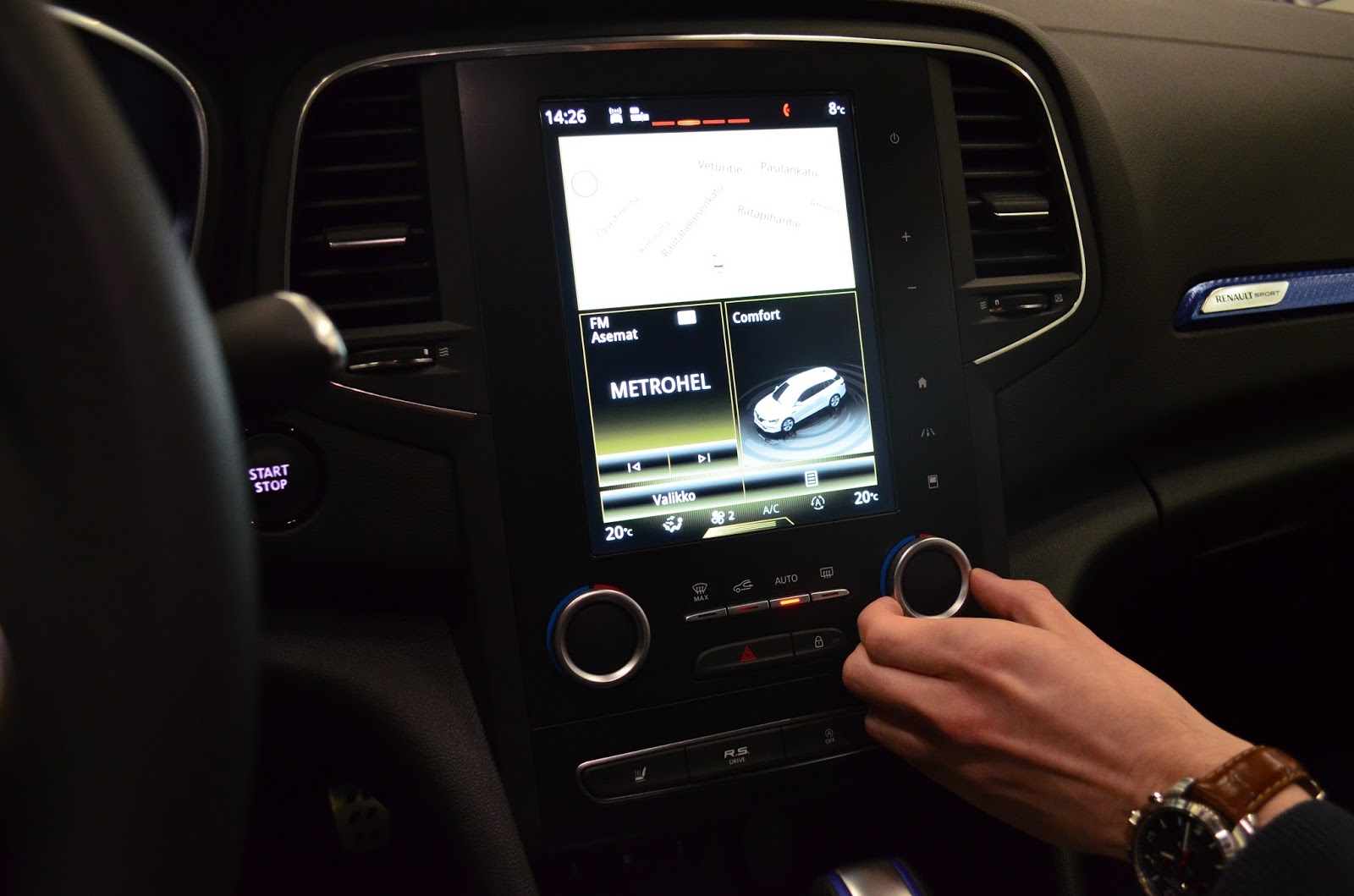
The white part of the screen is the sat-nav
sci-fi and UFO type stuff. Sort of the same can be said of the interior. The i-pad sized touch-screen and few buttons gives it a nice upmarket feel. Although I must say the center console display thing is quite confusing at first. And I can already see the material around the screen becoming peppered with finger-prints.


No doubting what car it is when the badge is that enormous.
This GT-model has all the techy stuff as standard. And as the GT-model it also has the top of the line 1.6 litre turbocharged engine developing a respectable 205 PS. This top-spec car also gives you the freedom to choose between different driving-modes. Which is something I feel every car has and somehow we should be excited about it. Anyhow, in this Mégane Sport Tourer GT stay away from the large touch screen button that says Sport. The cars 7-speed paddleshift gearbox will not now what is up and what is down. The ride which is perfectly decent for this car will be ruined. Coupled that with the body-hugging sport seats and your Renault GT will make you mental. Which makes the entire concept of the GT obsolete. It feels that the engine and gearbox do not get along all that well. The engine is happiest when overtaking in comfort mode. Here the engine works well with the gearbox and the car can make use most of the turbo grunt of which it has 280 Nm. The only enjoyable feature of the Sport button is that it enhances the rather fruity noise of that four-pot turbo.  

The rear is very unique. I also like the single exhaust.
This tech and the very apparent nature of it is very impressive but also the cars downfall. The fact that Renault has made a hot Mégane estate is very well and good but this a case of better idea than execution. There is nothing wrong in wanting the Mégane estate even though it isn't the most practical of the bunch. But there is only money lost if you buy the Sport Tourer GT.

PS. The price of this car is quite substantial, almost 40 000€ over here...  


torstai 6. lokakuuta 2016

Lamborghini Espada: Gandini art part 2


Since I have nothing to report from the Paris Motor Show (I wasn't there), let me present another Italian 70's sports/super car to you. Designed by the same person as the car from the previous post.

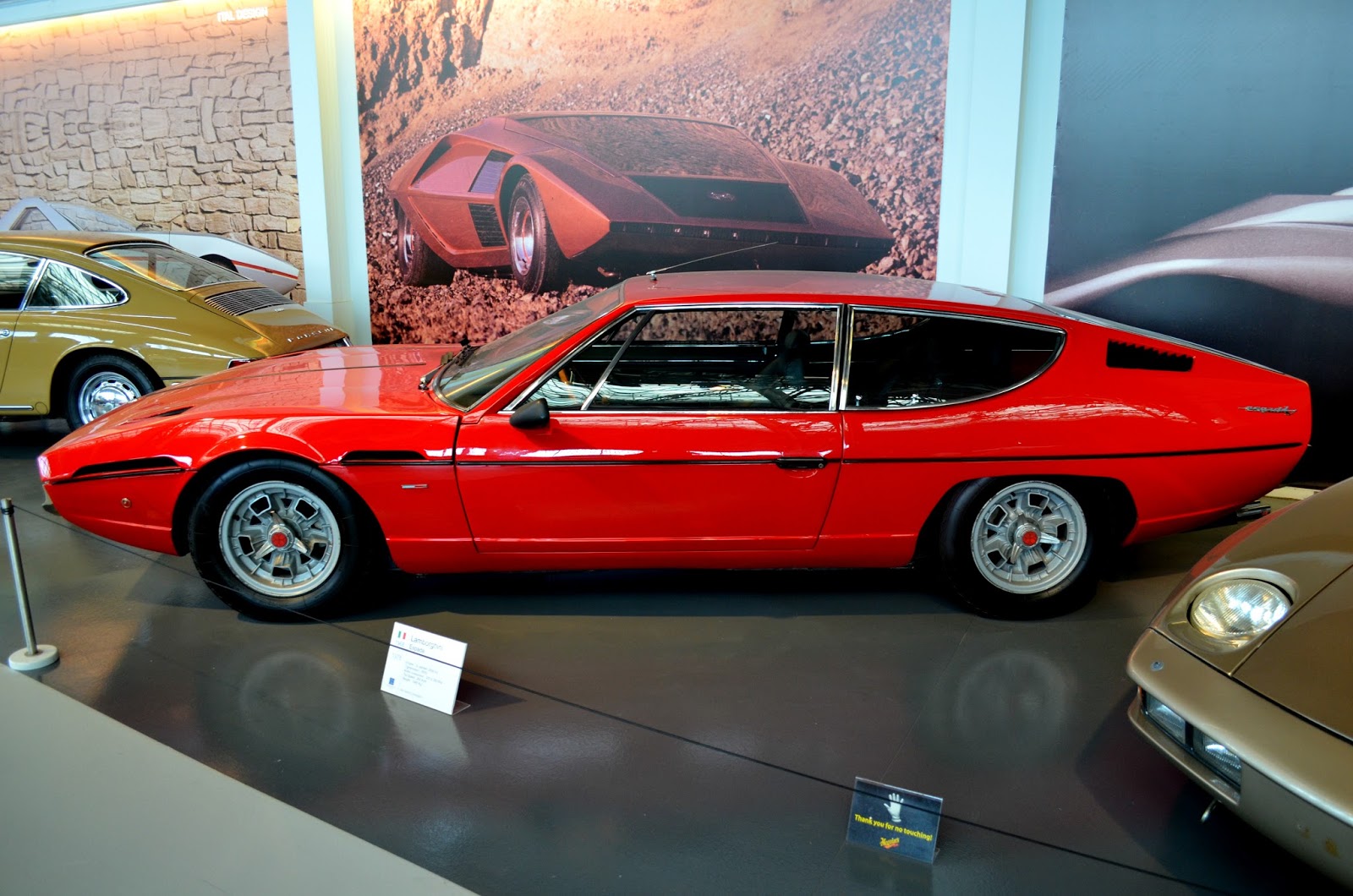
Lamborghini Espada in Rosso
The Lamborghini Espada was the most sold Lambo before the Countach. When you think most sold car remember which manufacturer we're talking about. They made and sold an overwhelming 1,217 Espadas during its ten years in production (1968-1978). This was huge for Lamborghini since they only sold a couple of hundred cars per model at that time. And for you classic car buyers, this also means that there are many Espadas out for sale today at quite a reasonable price - for a classic Lamborghini at least.

The 928 next to it looked like and SUV
As revealed in the title it was designed by one of Bertones greatest designer Marcello Gandini. The styling is sleek and... well, long. The long lines at the sides and the bonnet emphasize the length of this four-seater. Espada is Spanish and means sword. This charactarizes the cars sharp look. I just wonder if the name was invented after it was designed or the other way around. The cars other dimensions are as extreme as its length. It's under 1.2 meters high and close to 1.9 meters wide. Lamborghini had come a long way from the tractor dimensions. Some Gandini styling details are the NACA ducts on the bonnet, which I believe are functional. They better be, for the good of the engine lying beneath. 

NACA ducts give some depth to the king-size - large bonnet
The wheels are copied from the Miura
This vast car needs a powerful engine to hurl it forward. Luckily Lamborghini only makes engines with more than a few cylinders. The Espada has a version of Lambo's 3.9 litre V12 also seen in the Miura. Power output changed over the years from an initial 330 horsepower to 350 in the series II. Weirdly, for the series III the power was reduced to 325 HP. There were also ugly US-spec bumpers added to the series III which made it less desirable. That meant the series II sold the most and is the most wanted Espada today. 


The fuel filler is behind the plastic ducts

What comes to Italian supercars this may not be the most striking but it has an enormous amount of road presence. It is usable too with a large boot and two very usable backseats. Jay Leno talks about his Espada being his only car for some time. This is obviously possible only in a country where fuel prices are so low that it's almost viewed as a human right.


lauantai 1. lokakuuta 2016

Alfa Romeo Montreal: Italian art

As a car enthusiast, petrolhead, gearhead, and the rest of it, you think you know every car in the world. There is literally no more space in your brain for another interesting piece four-wheeled piece of design. Then while you're scrolling the internet, as you do at any time of day, you're confronted by a shape that you do not recognize but most definitely should.

Alfa Romeo Montreal in metallic gold.
Thankfully I was alone while feeling deep embarrassment of not knowing about the
Alfa Romeo Montreal. An Italian sports car created at the pinnacle of Italian exotica, the 70's and I didn't know what it was. The triangular grill design, though, gave away the cars manufacturer. I was immediately struck by the Montreal's elegant beauty. The classic proportions of a long bonnet and a sloping rear end have indeed stood the test of time.

Lovely subtle buldges on the bonnet
The most unique part of the Montreal is its front end. The grill-like contraptions on top of the headlights actually fold under the headlights when they are turned on. Does it make them pop-down headlights? On top of the bonnet there is an air duct which, weirdly, is blocked off and non-functional. That means the car has a useful piece of engineering used only for design purposes.
How Italian is that!
Seek out a video how the headlights work, it's amazing
Moving further towards the rear and the slots that look like vents you'll notice the shape of the door window. It has a familiar curved shape seen in the Lancia Stratos and Lamborghini Miura. Which is not by accident since the Montreal is designed by the same man as the Stratos and Miura, Signore Marcello Gandini. The six vents he put on the car work as vents for the cabin. But they are mostly a design feature and very successful one at that.

Look at the size of that steering wheel!
 Propelling this stylistic car forward is an Alfa bred 2.6 V8 closely related to the smaller capacity V8 used in Alfa Romeo's race cars at the time. It produces 200 horsepower and sends them all naturally to the rear wheels. The car was made from 1970-77 with only around 3900 produced. Alfa struggled to sell it since it went up against cars like the Porsche 911 but was more expensive.


So a car with an interesting engine, beautiful design, built by a charismatic manufacturer during a time when many iconic cars were built. This I think is why it has retracted into the shadow during the years, well, from ignorant me at least. Now though it's time to bring it to the light. I'm so bored by the Porsche 911.

A vintage bodyshape invigorated by many interesting details

sunnuntai 31. heinäkuuta 2016

A touch of racing livery


The F1 cars raced this weekend in Hockenheim which is about a one hour drive away from the Porsche headquarters in Stuttgart. So I thought I'd show you the Porsche which was next to the Porsche 356 Speedster replica at the Porsche gathering.
Porsche 911 with Gulf inspired livery
It was this glorious Porsche 911 in classic Gulf inspired livery. Now, I'm no Porsche enthusiast so I really don't know which year it is from. The only clue of the year I have is from the "whale tail" spoiler. It was fitted to different 911 models from 1973-1991. They were at first fitted to race spec 911's and later to sport spec Carreras and SC's. This and the single tailpipe has lead me to believe that this uniquely coloured 911 is either a 3.0 SC or a 3.2 Carrera. 

The redesigned front lip

The classic fixed spoiler called the whale tail
The mandatory Gulf Oil sticker
The Gulf livery is not official obviously but does make it stand out around all the other 911's from that period. It also has great looking black and orange wheels to round out the look. Also, I'm not so sure that bumper is an original to that car. The classic front lip is sort of missing which I think makes the car look more modern.


Much money has been invested to this 911 I'm sure. The Gulf colours are naturally attention seeking and rightly so. They were used on the legendary Porsche 917 that won Le Mans 24 hours in 1970 and 1971. Which means the classic colours are tightly woven to the Porsche racing history.

maanantai 25. heinäkuuta 2016

Porsche 356 Speedster: An iconic shape

There have been many shapes and sizes in the automotive history but only a few serve as an inspiration for future car design. But just a handful of those are so legendary that they are even replicated to the extent where the phrase 'copyright infringement' is under serious interpretation.

Porsche 356 Speedster Replica, some call this the Super Wide-Body.

We have seen the company Eagle leap into the car enthusiasts world when their Jaguar E-type inspired bespoke Eagle Speedster and Low Drag GT where featured in the - no introduction needed - TV show Top Gear. But there are many other companies that build cars which almost copies the shape of, usually, an iconic sports car. And to that note, I spotted a very beautiful Porsche 356 replica at a Porsche meet. I'm not a Porsche enthusiast and I don't mind a replica as long as it's exquisitely done, but I just can't help but wonder what the Porsche drivers in that meet thought about it. Maybe they turned their noses up at it, I don't know.

You could park a big block V8 in that rear end.


This one as you can see is not a straight up replica of the 356 Speedster. It has a much wider body, flared wheel arches, chrome bits missing in places and some chrome bits added. It is a much more track focused aggressive look compared to the original 1954 design 356A Speedster. Also I think it looks much more rounded and, dare I say, cuter than the original. Okay, there's quite a lot of bling going on as well. Even moles in their tunnels could see those wheels and the grills in front of the headlamps makes it look like a hamster going into battle. But somehow it works and adds character to the design. The elegant design from the 50's has been converted to something that could be described as childish. I like it.
The interior looks fantastic. Notice the driving gloves.


As for the performance, well, the original 356 produced between 1948 and 1965 had a power out put between 40 and 130 horsepower from engines ranging from a small 1.1 to a 2.0 litre four cylinder. As for the replica the engine can technically be whatever fits in the boot, but usually it is of the same size and out put as the original. Iets be honest it's more about looking good than going fast in this thing anyway.

A good Porsche 356 replica as this is quite expensive, nearly as expensive as an original in... ahem, not show room condition. So as a toy to show off a couple of times a year it is pricey. And then there's the problem of answering to a person who asks what it is. You have to say 'It's a Porsche 356 Speedster... Replica'. And I don't think I could live with that.

And finally, this is what an original Porsche 356 Speedster 1600 Super looks like.

maanantai 11. heinäkuuta 2016

Test drive: Toyota Celica 5th generation (T180)

The Toyota Celica has been gone for ten years now but after a production run of 35 years and seven different generations no wonder it is still one of the most iconic cars Toyota has ever produced.

I've recently driven the fifth generation Celica which in my view is also the prettiest of them all. When I got the opportunity to drive it I didn't think of the drive as a road test and that's why the pictures are pretty bad, well, they suck. But even though I still have some thoughts on it so here we go.
Toyota Celica 2.0 GT-i 16 in Black
This particular gen 5 Celica was the mid range 2.0 litre GT-i 16. The entry level was a 1.6 litre and the top of the range was the rally bred, turbocharged four-wheel drive GT-Four, which today may even be considered a classic. The 2.0 four cylinder is naturally aspirated as they usually were in the early 90's. It produced 156 horsepower through the front wheels which hurled the car to a reasonable 0-100 km/h time of 8 seconds dead. The car I drove was from 1993 but it had a tip top engine, gearbox and a completely new clutch. Which meant that it still had all that power left. The engine revved happily and the acceleration was sporty as it should be. The 2.0 litre engine is just powerful enough to make the car feel as special as it looks. The Toyota engine is reliable but what lets it down is a gearbox that wears out quite quickly. So that is what to look out for if you're thinking of buying one.
As you can see the age has taken its toll on the "organic" body.
The first generations of the Celica were quite angular, there were really no space for anything else than straight lines. But with the fourth gen Celica a change was made not only from rear wheel drive to front wheel drive but to also accommodate for some curvature in the styling. This was taken to whole new level with the fifth gen were the styling was called Super Round Organic Styling. Yeesh, that's some A-level design nomenclature. This style of design was highly debated and was and still is a love or hate look. This caused some problems though which are immediately apparent when you try to sit in the rear. It's not what you'd call... what's the opposite of claustrophobic? This quality is promptly forgotten when you remember this car has pop-up headlights. Which is the best exterior quality a car can have, end of discussion.

It does have a saucer-like shape to it
When the pillarless door is opened you notice a very driver centered interior, there's really nothing for the passenger to do. This particular Celica had working air conditioning which was nice. What I found to be the most interesting feature was that the steering wheel moved up when you took the key out of the ignition, and obviously moved down when the key was inserted in the ignition. This was for an easier exit from the car. It's a nice touch but the car or the seating position is not that low that the steering wheel needs to make room. But maybe I'm just short...

Everything in here worked even after 23 years, a plus for Toyota there.
As a conclusion, I think the 5th generation Celica has aged very well. Because it's front wheel drive it has also escaped the boy-racer image. This means anyone can own one. Now that Toyota brought back the affordable drift car in the GT86 and rumors are flying around the name Supra resurfacing how about a third comeback in the name of Celica.

tiistai 28. kesäkuuta 2016

Drive in the Alps: Mercedes-Benz SLC 200

When you travel to the alps for some ultimate driving pleasure one does not simply turn up in a diesel Renault Scénic. What the magnificent twisty roads of the largest mountain range in Europe deserve is not a boring and uninspiring family runabout. To conquer the Alps you need a car with less practicality and more excitement. Preferably a car with two seats and no roof, aka a roadster.
Enter the new Mercedes-Benz SLC.

Mercedes-Benz SLC 200 in iridium silver
The SLC is not a new type of roadster from Mercedes it is just the new re-branded name of the now 20 year old SLK. The original SLK was a huge success with over 300 000 units sold. This is partly down to the (then) groundbreaking metal folding roof which added stability and safety to the roadster. Fast forward 20 years and recipe is still the same, only now called the SLC. The recipe is very like the outgoing SLK in fact, as the SLC is only a facelift. The SLC gets only one new engine which goes to the top range AMG 43. Otherwise the SLC has to manage with the old engines from the SLK.

Or is it diamond silver, I'm not sure

This one had the 2.0 litre four cylinder turbo with and output of 184 horsepower through the rear wheels. Gone are the days of the Kompressor badge, which in my view has taken away some of the charm of the SLK/SLC. This new more efficient turbo unit is highly versatile. It revs happily up to 7000 rpm and the six speed manual this car had slotted nicely in to a higher gear ready for the engine to climb to 7000 again. In more docile driving the engine pulled surprisingly well from low revs. This is thanks to the peak torque of 300 newton meters coming in at a low 1200 rpm. With this versatility you're always in the right gear be it at the autobahn or 2000 meters high in the Swiss Alps. The SLC 200 is also available with the new 9-speed automatic. But who really wants an automatic in a roadster, really. Even though at low revs the engine sounded sometimes like a V6, it lacked character. It was versatile yes, but not trouser tingling or filled with eager like a puppy chasing leaves. In short it felt like a German machine, satisfied with any task you commanded it to do. Nothing more, nothing less.


If compered with the SLK, identical.
The AIRSCARF has three different power settings
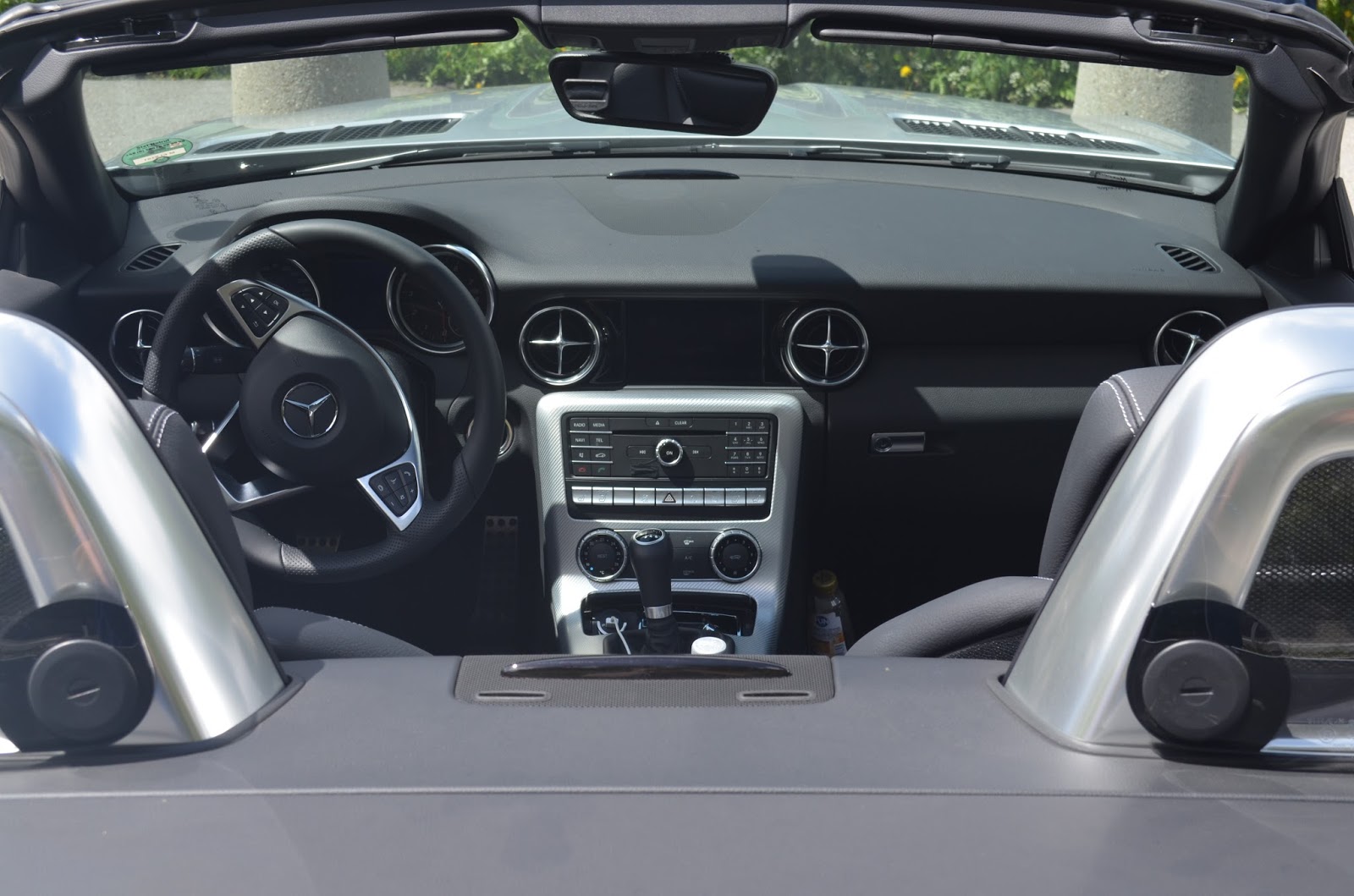
The interior hasn't changed at all in the SLC. It's almost identical to the 2012 SLK. The interior is just as the engine very functional but boring. The seats are tight enough to keep you in during hard cornering but comfortable enough so that the trip over the mountains doesn't feel like you've done it on an ox. This also reflects on the quality of the ride. I was never tired after sitting in the car for 6 hours straight. I'm guessing the AMG Line sport suspension is harder but I don't think it will be an issue, that's how well sorted the car is. Also adding to the comfort was that this car was fitted with the optional AIRSCARF (yes it is actually marketed in all caps). It is a heating system with vents in the headrest that blow warm around the neck area. This is especially handy when you drive your SLC up in the mountains with the top down and suddenly notice that there's snow around your car.
 

The SLC 200 is a pleasant drive. It drives well, the engine is resourceful and it does feel at home on tight mountain roads. The steering is light and quick and it managed 225 km/h on the autobahn. It made the journey over the Alps a great experience, but even so the car never left me wanting more. Maybe I'd appreciate the SLC 200 more if I did the journey in a Renault Scénic diesel.